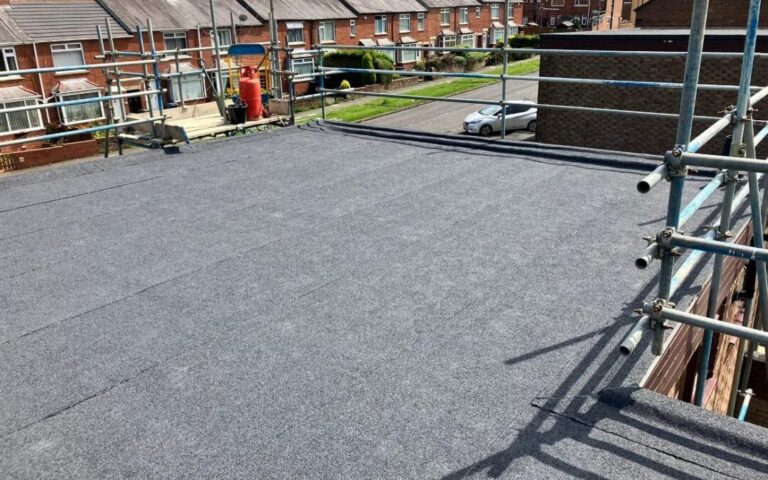


This question comes up sooner or later for anyone dealing with a flat roof. And there is no “one is better than the other” answer — both last decades when installed properly, and both fail quickly when they are not. What differs is the conditions under which each performs better. This article covers how they actually differ, when each suits, why they cannot be mixed and what to ask when a quotation arrives.
What torch-on bitumen is
A multi-layer covering of bitumen-impregnated rolls. The bitumen is polymer modified so that it stays flexible in cold and does not run in heat.
- SBS modification. More flexible at low temperatures, so it suits northern climates better.
- APP modification. More resistant to heat and UV, more common in southern climates.
It is laid in two layers: an underlay and a mineral-surfaced cap sheet. The laps are bonded with an open flame — the rolls are melted and pressed together.
We cover the technique in detail in our installation technology article.
What single-ply membrane is
A single-layer synthetic covering, laid in rolls and hot-air welded. Three main types are used:
- PVC. The longest established, welds readily, with a wide range of preformed details. It contains plasticisers, which migrate over time.
- TPO. Contains no plasticisers, so it changes less over time. Welding demands a tighter temperature window.
- EPDM. Synthetic rubber, extremely flexible. Joined with adhesives and tapes rather than hot air.
Three fixing methods are used: mechanical, adhered and ballasted — the same ones used for insulation.
One point often left unstated in quotations is worth noting: membrane thickness varies by a factor of several. A thinner and a thicker sheet of the same type look identical, but mechanical resistance and service life differ markedly. So when comparing quotes the word “PVC” or “TPO” alone says nothing — the thickness matters too.
The second point is whether the membrane is reinforced. A scrim gives dimensional stability and tear resistance. For mechanically fixed systems it is essential, because load concentrates at the fastener points.
2
main systems: torch-on bitumen and single-ply membrane
1–2
layers — the difference that shapes all the others
0
ways to mix bitumen with PVC — they are incompatible
The main differences
How much will your roof cost?
Enter the roof area and covering type to get an indicative price in a minute. Or call us for an instant answer.
- Free on-site inspection
- Reply within 48 hours
- Warranty up to 20 years
| Criterion | Bituminous | Single-ply |
|---|---|---|
| Number of layers | Two | One |
| Thickness | Greater in total | Thinner |
| Weight | Considerably higher | Light |
| Installation | Open flame | Hot air |
| Fire risk during work | Present | Practically none |
| Complex details | Easier to form on site | Preformed components used |
| Local repair | Simple, material widely available | Needs matching type and equipment |
| Mechanical resistance | Higher, thanks to mass | More vulnerable to puncture |
Number of layers: the fundamental difference
The fundamental difference — the number of layers
Torch-on bitumen is laid in two layers, single-ply in one. Almost everything follows from that: weight, installation speed, how complex the details are and the logic of any repair.
This is the most important point, and it gets too little attention.
Bitumen has redundancy. Two layers with staggered laps mean that damage to the top layer is not yet a leak — there is a second beneath it. That buys time to notice and put it right.
Single-ply has none. One layer: puncture it and water is inside. On the other hand there are no interlayer problems either — no space for moisture to accumulate between plies.
From which follows a practical conclusion: installation quality and protection from mechanical damage are critical for single-ply. Where a roof is walked on or worked on regularly, that is a substantial argument.
There is a flip side worth stating honestly. A two-layer system has twice as many laps, and a lap is always weaker than continuous sheet. So bitumen’s redundancy only works when both layers are bonded properly and the laps are staggered.
Badly executed two-layer work is not safer than well-executed single-ply. Redundancy is an opportunity, not a guarantee.
Installation: flame or hot air
A difference that often decides the choice, though it has almost nothing to do with the covering itself.
Bituminous membrane is melted with an open flame. That means hot work, with all that follows:
- Fire precautions and a fire watch after the work are required.
- Insurers impose their own conditions.
- Over timber construction or in an occupied building the risk is higher.
- On some buildings open flame is simply not permitted.
Single-ply is welded with hot air — no flame. It is therefore often chosen not for its properties but because there is no other way to work.
Flame-free bituminous options do exist — self-adhesive or hot-air welded. They cost more, but they address exactly this problem.
Weight: when the structure sets the limit
A two-layer bituminous system weighs considerably more than a single membrane. In new build that is irrelevant — the load is in the design.
In refurbishment it matters a great deal. Particularly in these cases:
- Where the new covering goes over the existing one without stripping.
- Where the structure is old and has little reserve.
- Where the deck is timber or profiled steel.
- Where a solar array or terrace is planned alongside.
In those cases the lightness of single-ply outweighs every other argument.
Details and complex shapes
A roof is rarely an empty rectangle. Chimneys, vents, parapets, stair exits — each is a detail.
Bitumen is formed on site. Heated, it becomes plastic and wraps a complex shape. A skilled installer can solve an unusual detail with the materials to hand.
Single-ply uses preformed components — corners, pipe collars, trims. The result is neater and repeatable, but an unusual detail needs either a special component or careful hand work.
In practice: on a roof with many complex details bitumen is often easier, while on a large open area single-ply is faster.
Repair: what happens in ten years
A question almost nobody asks when choosing, yet it governs the real cost over the roof’s life.
Bitumen is simple to repair. The material is available everywhere, most roofers know how to lay it, and a local patch is torched on without special equipment. Finding someone to repair it in ten years will not be a problem.
Single-ply needs the same type of material and welding equipment. A PVC patch will not bond to TPO. And an old PVC membrane loses plasticisers over time and becomes harder — welding it is more difficult than welding new material.
From which a practical tip follows: if you choose single-ply, record which type it is and keep that with the rest of the roof documentation. In ten years nobody will remember.
Why bitumen and PVC cannot be mixed
Why bitumen and PVC cannot be mixed
PVC membrane and bitumen are chemically incompatible — direct contact degrades the membrane. If PVC is laid over old bitumen, a separation layer is essential, otherwise the covering fails early.
A technical detail worth every client knowing, because the error is common and expensive.
PVC and bitumen are chemically incompatible. PVC contains plasticisers which migrate into the bitumen where they touch. The PVC becomes brittle and the joints weaken. The process is slow, so the consequences do not appear straight away.
When it becomes relevant:
- Where PVC is laid over an old bituminous covering without stripping it.
- Where a repair uses a different material from the existing one.
- Where components from different systems meet at a detail.
The solution is simple: a separation layer goes between them — geotextile or a purpose-made film. It is standard practice, but it has to be specified deliberately.
TPO and EPDM contain no plasticisers, so the problem does not arise with them — though a separation layer is still often used for mechanical reasons.
Colour and heat
A functional difference that gets little attention, though on a summer day you can feel it with your hand.
Bituminous membrane is dark. It absorbs solar radiation, so on a sunny day the surface gets far hotter than the air. Single-ply is often light — white or grey — and reflects part of that radiation.
What that changes in practice:
- Cooling load. Top floors get hotter in summer under a dark covering. In an air-conditioned building it shows on the bills.
- Solar panel output. Hot modules perform worse, so a light surface beneath them helps.
- Ageing of the covering itself. The greater the temperature swings, the harder the material and the details work.
- Snow and ice. A dark covering speeds melting, which is not always good — meltwater reaches a cold edge and freezes there.
It should not be overstated: on a properly insulated roof the difference indoors is small, because the insulation does its job. But for the covering and the details, temperature always matters.
Light-coloured bituminous cap sheets with reflective surfacing also exist — they narrow the gap, but cost more.
Service life: what it actually means
Manufacturers quote similar decades for both. And it is worth saying plainly: those figures describe the potential of the material, not the future of your particular roof.
In practice service life is governed by entirely different things:
- The fall. Standing water ages both coverings. A roof that ponds will not reach the quoted life whatever the material.
- Quality of the details. Most leaks appear not in the field but at parapets, outlets and penetrations.
- Fixing. An incorrectly calculated density at the corners means one storm can do what twenty years of UV would not.
- Mechanical impact. Foot traffic, equipment, maintenance work.
- Maintenance. Cleared outlets and an annual inspection extend service life more than a dearer material does.
From which follows perhaps the most important conclusion in this article: the gap between good and bad workmanship is wider than the gap between these two coverings. It is worth putting more attention into how the work will be done than into which material is better.
When to choose bitumen
- The roof has many complex details. Forming on site is easier.
- The structure carries the weight and load is not the limiting factor.
- Redundancy matters. Two layers buy time to notice damage.
- The roof will be walked or worked on. Greater mass withstands mechanical impact better.
- You want straightforward future repairs without depending on one supplier.
- The existing covering is bituminous and the new one goes over it.
When to choose single-ply
- The structure limits weight. An old deck, timber, profiled steel.
- Open flame is not permitted. Occupied building, timber construction, strict requirements.
- A large uninterrupted area. Faster to lay, fewer laps.
- An inverted or usable roof. Single-ply is often easier under ballast.
- Low build-up height matters. Where the height budget is tight.
What to ask when a quotation arrives
Whichever type is chosen, a few questions are worth asking:
- Which exact type and modification? Not “bitumen” but SBS or APP. Not “membrane” but PVC, TPO or EPDM.
- How many layers? A single-layer bituminous system is an economy that removes the whole redundancy advantage.
- How is it fixed? Mechanically, adhered or ballasted, and whether the density is calculated by wind zone.
- How are the details solved? With preformed components or on site.
- Is a separation layer allowed for where dissimilar materials meet.
- What warranty applies and what it covers — material, workmanship or both.
The most common mistakes
- Choosing on price alone. The gap between the coverings is smaller than the gap between good and bad workmanship.
- PVC over bitumen with no separation layer. The consequences appear a few years later.
- One layer of bitumen instead of two. The redundancy is lost and little is saved.
- Not recording which membrane was installed. Repair in ten years becomes harder.
- Open flame where it should not be used. The risk is out of proportion to the saving.
- Uniform fixing density across the roof. Wind load is highest at the corners.
- Recovering without correcting the fall. Whichever material is used, the ponds remain.
What drives the cost
- Type and grade of covering — differences between manufacturers are large.
- Number of layers in a bituminous system.
- Fixing method — adhered systems cost more than mechanical.
- Number of details — they cost more per square metre than the field.
- Whether the old covering is stripped and where it is disposed of.
- Access — height, vehicle access, whether the building stays in use.
General pricing is set out in our flat roof cost article.
Not sure which covering to choose?
We survey the roof, assess the structure and the details – and tell you which solution makes more sense in your case.
How to decide
Choosing a covering: 6 steps
Assess the structure
Establish whether the structure limits weight. If it does, single-ply already has the advantage at this stage.
Assess working conditions
Check whether open flame is permitted: building use, deck material, whether the premises stay in operation.
Count the details
Assess how many penetrations, parapets and unusual shapes the roof has. Many details favour bitumen.
Define the use
Answer whether the roof will be walked on, and whether an array, terrace or ballast is planned.
Check the existing covering
Establish what is on the roof now, whether it is being stripped and whether a separation layer is needed.
Compare quotations
Compare not just the figures but the exact type, layer count, fixing density and how the details are solved.
Related reading
- Bituminous membrane installation technology
- Flat roof repair
- Flat roof structure and layers
- Roof renovation
Frequently asked questions
There is no single answer. Both last decades when installed properly and both fail quickly when they are not. What differs is the conditions: single-ply wins where weight is limited or open flame is not allowed, bitumen where there are many complex details or the two-layer redundancy matters.
For redundancy. Damage to the top layer is not yet a leak – there is a second layer beneath with staggered laps. That buys time to notice and repair. A single-layer system does not have that advantage.
Yes, but a separation layer is essential if the membrane is PVC. PVC contains plasticisers that migrate into bitumen: the membrane becomes brittle and the joints weaken. TPO and EPDM do not have this problem.
Bitumen. The material is available everywhere, most roofers can lay it, and a patch is torched on without special equipment. Single-ply needs the same type of material and welding equipment, and old PVC becomes harder over time and more difficult to weld.
PVC is the longest established and welds readily, but contains plasticisers that migrate over time. TPO has none, so it changes less, though welding needs a tighter temperature window. EPDM is synthetic rubber – highly flexible, joined with adhesives and tapes rather than hot air.
So that it can be repaired in ten years. A PVC patch will not bond to TPO, and without a record of the type the repairer has to guess. That information is worth keeping with the rest of the roof documentation.