



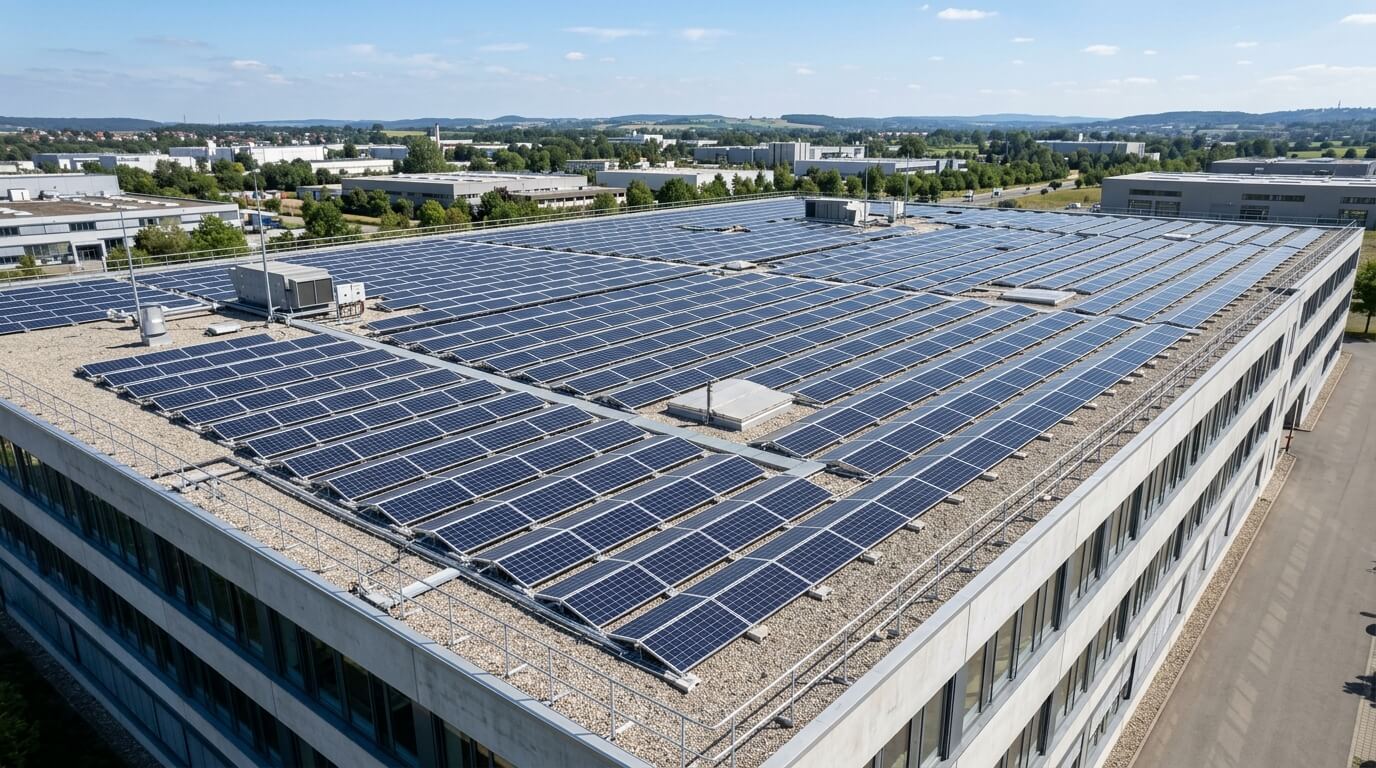
A commercial roof is large, empty and unshaded — so the question of an array comes up almost every time. But the decision usually gets made by calculating generation and payback, with the roof considered last. This article covers what you need to know about the roof before signing with a solar supplier, why two separate contractors are a risk, and what is worth agreeing in advance.
The question asked too late
The question often asked too late
Whether the roof is ready for an array is often considered only after the system is designed. The right order is the reverse: assess the roof first, then lay out the modules.
The typical sequence runs: a solar quotation arrives, generation is calculated, the budget is approved — and only then does anybody climb onto the roof.
The correct sequence is the reverse. Two questions come first:
- Will the structure carry it?
- How much service life does the covering have left?
If the answer to the first is no, the project changes fundamentally. If the answer to the second is short, the scope and cost of the project change, because the roof has to be dealt with first.
Both answers cost one survey. Not having them costs considerably more.
Why it is harder on a commercial roof
Commercial roofs usually sit on profiled steel rather than a concrete slab. That changes almost everything.
- There is almost no reserve. The structure was designed for specific loads and no more.
- Ballasted fixing is often impossible. There is nowhere to put the weight.
- Wind is the governing load. On a light roof it outweighs everything else.
- Snow accumulates unevenly. Rows of modules act as barriers.
We cover this construction in detail in our commercial roofs article.
2
loads calculated together: the array and the snow
25–30
years — the system's life, so the covering must match it
1
core economic question: the covering's remaining life
Loads: what gets calculated together
How much will your roof cost?
Enter the roof area and covering type to get an indicative price in a minute. Or call us for an instant answer.
- Free on-site inspection
- Reply within 48 hours
- Warranty up to 20 years
A common error is assessing only the mass of the modules. Everything is totalled at once:
- Modules and frames. Modest in themselves.
- Ballast, on a ballasted system — often the largest part.
- Wind uplift, with enhanced zones at corners and edges.
- Snow load, including drifting behind rows.
- The existing build-up — particularly where several layers remain from earlier repairs.
- Maintenance loading — people and equipment.
The fifth is the one most often skipped. If several old layers already sit on the roof, there may be no reserve left for an array — and stripping them creates some. That is one more reason the roof and the array are settled together.
Snow: a load the original design may not contain
Snow — a load the original design may not contain
Older commercial roofs were designed without the added weight of an array. Add the modules and winter snow, and the load can exceed what the roof was calculated for — so the snow zone is assessed in advance.
This deserves separate attention, because it is not obvious.
On a bare flat roof snow distributes fairly evenly. Install rows of modules and that changes: wind carries the snow, and it drifts behind the rows.
Instead of an even layer you get concentrated zones. On a light structure that matters, and the original building design most likely never contained that scenario.
The practical conclusion: a structural assessment is not a formality. And it has to be done against the actual layout, not in general terms.
Remaining service life: the core of the economics
An array is long-lived equipment. The covering has a service life of its own. And here lies a simple piece of arithmetic that often falls outside the spreadsheet.
If the roof has ten years left and the array is planned for twenty-five, at some point it all has to come off.
For a business that means more than the cost of the works:
- Dismantling, storage and reassembly.
- Lost generation over that period.
- Additional project management and co-ordination.
- The risk that system components will have changed by then.
So the rule is simple: if the covering’s remaining life is shorter than the array’s, the roof is dealt with before installation. Not in a year — before.
How to assess what is left is set out in our warranty and service life article.
One project or two
Here lies the key commercial decision, and it is not a technical one.
If the roof needs work, two options arise:
| Option | Advantage | Risk |
|---|---|---|
| One project | Single liability, co-ordinated details | Programmes must be aligned |
| Two separate contractors | Easier to compare prices | Liability divides; a leak does not |
The problem with the second only surfaces when something goes wrong. The roofing contractor says the installers damaged the covering. The installers say the covering was already poor. The client pays the bill.
When the work happens together that problem does not exist — the details are built at one time and liability stays in one place.
What to agree before the works
If two contractors are used after all, several things belong in writing.
- Who does the covering work. Welded feet, protection mats, details — that is roofing work, not electrical.
- The roof’s condition beforehand. The whole area is photographed, not just the installation zone.
- Who is liable for a leak in the installation zone, and for how long.
- Whether the roof warranty still applies after installation. That needs confirming in writing, not assuming.
- How maintenance will work. Who goes on the roof, how often, and whether walkways exist for it.
- What happens if the covering needs replacing before the array’s life ends.
The fourth matters most. A roof warranty often ceases to apply where others have worked — and sometimes across the whole roof, depending on the conditions.
Access and maintenance on a large array
A commercial roof carries many modules, covering a large share of the area. That changes roof maintenance for the rest of its life.
- Outlets must stay reachable without dismantling modules. A buried outlet will eventually block, and nobody will see it.
- Row spacing must fit a person with equipment, not merely avoid shading.
- Walkways where the roof is crossed. Service visits are frequent, and gritty boots wear the covering.
- Cables raised on supports. Lying on the covering they abrade the surfacing and freeze into ice in winter.
- Edge zones. Clear areas are left at parapets and the overflow.
A practical thought: a few modules fewer is cheaper than a roof half of which nobody sees for ten years. The layout is agreed not only with the electrical designer but with whoever will maintain the roof.
Why outlet access is critical is covered in our drainage article.
When the array is not yours: roof leasing
Increasingly an array on a company roof is installed and operated by a third party, with the owner receiving rent or a better electricity price. Commercially that is attractive — no capital outlay. But the roof risk stays with the owner, and that has to be in the contract.
What to establish before signing:
- The contract term against the covering’s remaining life. A twenty-year agreement over a roof with ten years left programmes in a conflict.
- Who pays for removal if the roof needs replacing during the term.
- Who is liable for a leak in the installation zone, and how the cause is established.
- Whether penetrations are permitted, or ballasted fixing only.
- What condition the roof is handed over in — recorded photographically and in a schedule.
- What happens at the end of the term. Whether the array is removed, and in what condition the roof comes back.
The second point causes the most disputes in practice. To an operator the roof is a substrate, not an asset — their interest is generation, not the condition of the covering. So the contract has to say clearly what happens when the owner needs access.
The practical recommendation is simple: survey the roof before signing a lease and make the finding part of the contract. It is the only way to prove later what the starting condition was.
How an array changes maintenance costs
Something absent from the payback spreadsheet that turns up every year thereafter.
An array does not change the need for roof maintenance — it changes its duration and complexity:
- Inspection takes longer. Part of the area has to be walked around rather than looked over.
- Some zones become unreachable without dismantling modules — if the layout was never agreed.
- Clearing outlets is harder where there is little room around them.
- Any repair needs co-ordinating with the array operator — for safety and for generation.
- The array’s own servicing adds visits, bringing more people onto the roof.
For a business that means the annual roof maintenance budget after installation is higher, not the same. It is a modest sum, but worth allowing for at the outset rather than discovering in year one.
Conversely, a well-planned layout with walkways and clear access to outlets reduces that difference to almost nothing. It is one of the few cases where a better design shows up immediately in operating costs.
Insurance
On a commercial building this is a separate area that roofers rarely raise, and should.
- Hot work. Where torching happens above an operating warehouse, insurers may impose their own conditions. Sometimes that decides the covering type.
- Roof condition. Some policies exclude damage arising from a poorly maintained roof.
- Effect of the array. It is worth checking whether an installed array changes the property cover.
- Maintenance records. As with warranties, the position is weaker without documentation.
The general rule is the same as for warranties: documented maintenance is the cheapest thing you can do, and the only argument available when a dispute arises.
When the array is up and the covering needs replacing
A situation best avoided, but one that occurs.
The options, cheapest first:
- Phased replacement. The array comes off zone by zone: part removed, covering relaid, part returned, then on. Generation does not stop entirely.
- Lifting without dismantling. Some systems allow the frame to be raised and shifted. It depends on the type.
- Complete removal. Technically simplest, practically dearest — it needs storage space and time to rebuild.
In every case the opportunity is worth taking: while the array is off, correct the fall, replace the outlets and provide an overflow. The next chance to reach them will be twenty years away.
The most common mistakes
- Planning the array without surveying the roof. Loads and remaining life emerge too late.
- Installing over a covering with a few years left. The most expensive mistake of all.
- Snow drifting behind rows not assessed. The load is concentrated, not even.
- Old layers not counted. There may be no reserve left for the array.
- Electricians doing the covering work. A detail is roofing work.
- No agreement on liability. When the roof leaks, two contractors point at each other.
- Outlets built over. Water accumulates where nobody looks.
- Warranty status never checked. Assumed instead of confirmed in writing.
What drives the cost
- Whether the roof is put right first and to what extent.
- Fixing method — ballasted, welded or mechanical.
- Protection mats and the area they cover.
- Structural strengthening, where required.
- Walkways and access provision.
- Investigations — survey, structural assessment, core samples.
Planning an array on your company's roof?
We assess the structure, the covering and its remaining life – so the array does not become an obstacle in ten years.
How preparation proceeds
A commercial roof for solar: 6 steps
Roof survey
Covering condition, number of layers and remaining service life are assessed. Core samples are taken where needed.
Structural assessment
Loads are calculated with ballast, wind and snow drifting behind rows, against the actual layout.
Deciding the scope
Whether the roof must be dealt with first, and whether the works run as a single project, is established.
Agreeing the layout
Edge zones, outlet access, walkways and row spacing are all agreed.
Settling liability
Who does the covering work, who is liable for a leak and whether the roof warranty survives are agreed in writing.
Works and documentation
The roof is prepared and the array installed. Condition is recorded before and after and a maintenance schedule agreed.
Related reading
Frequently asked questions
With two questions: will the structure carry it, and how much life does the covering have left. Both answers cost one survey, and not having them costs considerably more. Generation figures without those answers are assumptions.
Such roofs usually sit on profiled steel rather than concrete. There is almost no reserve, ballasted fixing is often impossible, wind becomes the governing load, and snow drifts unevenly behind the module rows.
A single project is safer. With two contractors liability divides but a leak does not: the roofer says the installers damaged the covering, the installers say it was already poor. The client pays the bill.
That needs confirming in writing rather than assuming. A warranty often ceases to apply where others have worked, and sometimes across the whole roof depending on the conditions. Inform the roofing contractor beforehand and obtain approval of the approach.
Enough for a person with equipment, not merely enough to avoid shading. Otherwise part of the roof becomes physically unmaintainable. A few modules fewer is cheaper than a roof half of which nobody sees for ten years.
The cheapest route is phased replacement, taking the array off zone by zone so generation does not stop entirely. Some ballasted systems allow the frame to be raised and shifted. While it is off, correct the fall and the outlets – the next access is twenty years away.


