



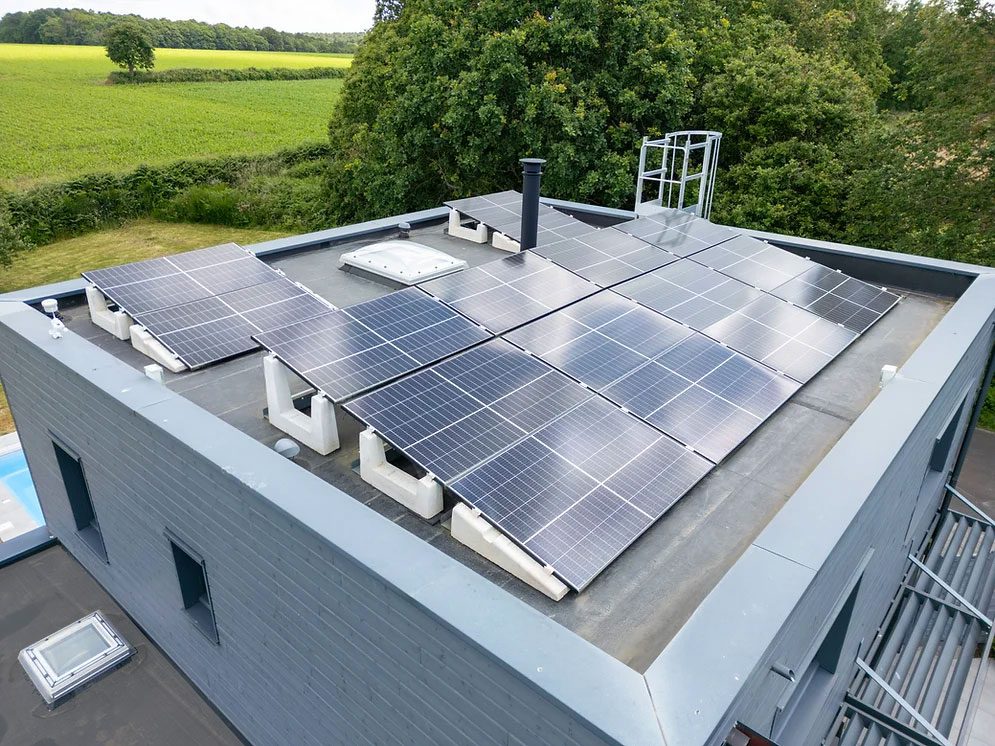
Solar panels on a flat roof last 25 to 30 years. The covering beneath them does not necessarily last as long. That is where the most expensive mistake arises: an array is mounted on a covering with five years left, and a few years on it has to be dismantled so the roof can be recovered.
This article is written from a roofer’s perspective, not a solar salesperson’s. It is about what to check before ordering the installation.
Solar is a good investment, but it pays back over many years — and the roof beneath it has to last just as long. If you save on the roof and it starts leaking two years later, the benefit of the array quickly turns into a problem. So the roof is worth seeing not as a surface to mount modules on but as part of a system whose reliability decides the whole project.
First question: how much life is left in the covering
The roof first, the modules second
An array will generate power anywhere, but if the covering beneath it lets water through, the problem ends up under the whole system. So installation starts not with the modules but with the state of the roof covering.
The array’s service life must match the covering’s or be shorter. A practical rule:
- A covering new or under 10 years old — mounting is possible without extra work, if it is sound.
- A covering 10–20 years old — worth assessing the condition and considering renewing it together with the array. One lift instead of two.
- A covering over 20 years old or with leaks — the roof must be sorted first. Dismantling and reassembling the array costs more than a timely recovering.
How to assess a covering’s condition is set out in the recovering an old roof article. The key thing to grasp is that the covering’s age is not a detail — it decides whether the array will have to be dismantled before it even pays back. So we start every conversation about solar on a flat roof with this question.
Will the roof carry the load
A solar system adds a permanent load, and a ballasted mount adds more still. What is assessed:
- Permanent load — the modules, the mounting structure and ballast, if the system is ballasted.
- Snow load — modules change how snow distributes on the roof, gathering under them and at the edges of the rows, so the load is locally higher than on a bare roof.
- Wind load — greatest at the parapets and roof corners, where uplift forms and can lift or overturn modules.
Load assessment is not a formality. Flat roofs are designed with a specific margin, and it does not always allow a ballasted system to be added. The decision must be confirmed by a structural engineer, based on the building design.
25–30
years — the array's life, so the covering must match it
2
base types: ballasted and mechanically fixed
1
the right order: the roof first, then the modules
Ballasted or fixed base
How much will your roof cost?
Enter the roof area and covering type to get an indicative price in a minute. Or call us for an instant answer.
- Free on-site inspection
- Reply within 48 hours
- Warranty up to 20 years
Ballasted system
The structure is held by its own weight and ballast (concrete slabs or gravel). The waterproofing is not penetrated — the greatest advantage, because every penetration avoided is one potential leak point fewer. The downside is a higher load on the roof and the need for a protection layer under the supports, so the weight does not abrade the covering. For flat roofs this is usually the first choice where the structure allows.
Mechanically fixed system
The supports are fixed to the load-bearing structure. The load is lower, but each fixing point is a penetration of the waterproofing that must be sealed separately — with a collar and a check, not a patch of sealant. Used where the structure cannot carry the ballast or where wind load demands firm anchoring. Then the number of penetrations and their quality become decisive for the roof’s watertightness.
What we choose
For flat roofs with a bituminous or membrane covering, a ballasted system is almost always better — fewer penetrations mean fewer potential leak points. Mechanical fixing remains the solution when the load calculation does not work out otherwise. The choice between the two is not a matter of taste — it is decided by the structure’s capacity and the local conditions, so it is made after a survey, not in advance.
| Trait | Ballasted | Mechanically fixed |
|---|---|---|
| Penetrations | None | Yes, must be sealed |
| Load on the roof | Higher (ballast) | Lower |
| Risk to the covering | Lower | Depends on detail quality |
How the waterproofing is protected
The most common installation mistake is placing supports straight on the covering. Under them a protection layer is essential: geotextile or rubber pads that spread the point load and protect the covering from abrasion. Without it, ballast abrades the covering exactly where it cannot be seen — under the support — and the problem only shows up once it starts leaking.
Also important:
- support edges must not be sharp, so they do not cut the covering;
- cable runs must not lie straight on the covering or abrade it in the wind — they are led in proper trays;
- between the module rows there must be maintenance paths and access to the outlets;
- outlets must not end up under modules — they cannot then be reached and cleaned.
The last point is the most often broken in practice. A blocked outlet under solar modules is a direct route to water pooling and covering failure in a spot nobody can see. So the module layout plan must be coordinated with the drainage, not the other way round — modules are placed not only for the sun but so the roof can be maintained.
Planning solar on a flat roof?
We assess the roof's condition and load before installation – so the array does not have to come off in three years.
Which covering suits best
All the main flat-roof coverings work with solar, but the nuances differ:
- Torch-applied bitumen — reliable, easily repaired locally, and a two-layer system is forgiving of minor damage. A dark colour heats up more, so a gap between the modules and the covering matters for ventilation.
- PVC and TPO membranes — pale, they heat up less, which even slightly improves module output. With PVC it matters that the support material is compatible — some plastics are incompatible with PVC and can damage the covering over time.
A detailed comparison is in the article on bitumen versus membrane. What matters most is not the material but that the covering is new, or that its remaining service life matches the array’s.
What to ask the solar installer about the roof
What to ask the solar installer about the roof
How the base is fixed and whether there will be penetrations, who seals the details, whether access for roof maintenance remains. If the only answer is “we’ll sort it”, it is worth bringing the roofer into the job too.
Solar installers are electrical specialists, which is natural. But the roof is a separate field, so it is worth asking a few questions that protect the waterproofing.
- How will the modules be held — by ballast or fixings? The answer decides whether the covering is penetrated.
- Who will be responsible for the roof’s watertightness after installation? If the installer penetrates the covering, who guarantees the detail will not leak a few winters on?
- Will access to the outlets and details remain? A row of modules over an outlet makes cleaning impossible without dismantling.
- Has the covering’s remaining condition been assessed? If not, it is worth bringing in a roofer before installation, not after.
It is best when the roofer and the installer talk before the design. Coordinated work removes the question of “whose fault it is” should a leak appear later. How a reliable base is built without damaging the covering is on the services page.
When it is worth renewing the covering first
This is perhaps the most important roof-related decision. An array ties the covering beneath it down for decades, so the covering’s age becomes critical.
- Covering up to 10 years and sound — mount straight away.
- Covering 10–20 years — worth renewing together, because one lift is cheaper than two separate ones.
- Covering over 20 years or with leaks — the roof must be sorted first.
The logic is simple: if the covering has to be replaced in five years, the whole just-installed array will have to come off. Dismantling and reassembly cost more than a timely recovering, and the array does not generate in the meantime. So an honest conversation about the covering’s age before installation often saves the most over the array’s whole life.
Maintenance: how modules change roof care
Modules do not only generate power — they change how the roof beneath them is maintained. That is worth allowing for at the planning stage.
- Access to the outlets must remain. Otherwise a blocked outlet goes unnoticed until water builds up.
- Leaves and debris gather under modules, where they are harder to remove — inspection becomes more important, not less.
- Between the rows paths are needed so the roof can be inspected without stepping on modules or fragile covering.
So we plan access and drainage before setting the module rows. A roof that cannot be maintained goes leaky sooner, however good the array is.
Solar and a green roof together
Increasingly, greenery and modules are wanted on the same roof. It is possible and even beneficial: a green surface cools the modules’ surroundings, and cooler modules work more efficiently. What matters is that the supports do not penetrate the waterproofing — ballasted bases are usually used. Such combinations are worth planning together; more on green roof installation is set out separately.
Common mistakes combining an array and a roof
Almost all problems with flat-roof solar arise not from the modules but from the roof and the array being planned separately.
- Mounting on an aged covering. The most expensive mistake — the covering fails a few years on, and renewing it means dismantling the whole array.
- Penetrations sealed with sealant. Instead of a proper detail, a layer of sealant that lasts a season and then begins to drip.
- Supports set straight on the covering. Without a protection layer, ballast abrades the covering over time.
- Outlets under module rows. Drainage becomes inaccessible and a blockage goes unnoticed.
- Wind zones not calculated. Uniform ballast across the whole area means corners are too weak where the forces are greatest.
What they share is that they do not show on installation day but appear a season or two later. So the roof side is worth entrusting to a roofer, not left to the electricians.
The order that saves money
- Assessment of the covering’s condition and remaining life.
- Structural load check with wind and snow assumptions.
- If needed — recovering and correcting the fall while the roof is still clear.
- Choosing the base type together with the roofer and the installer.
- Mounting the modules and checking the penetrations are watertight.
The reverse order — the array first, the roof question later — costs the most. Dismantling, storing and reassembling the modules often costs more than the recovering itself, and the array does not generate during it. So it is best for the roofer and the installer to talk at the planning stage. The whole subject is in the complete flat roof guide, and how to get in touch on the contact page.
Frequently asked questions
Properly installed, no. The risk comes from three things: setting supports straight on the covering without a protection layer, penetrating the waterproofing when mechanically fixing, and blocking outlets with modules. All three are solved at the design stage, not after installation.
The load is the modules, the mounting structure and, if ballasted, the ballast. Added to that are snow and wind loads, which distribute differently because of the modules than on a bare roof. The exact figures must be confirmed by a structural engineer to the building design.
Technically yes, but it almost never pays. Modules last 25–30 years, so the covering beneath must have at least as much margin. If it has less, the array will have to be dismantled and reassembled – costing more than a timely recovering.
For a flat roof a ballasted system is usually better, because it does not penetrate the waterproofing. Mechanical fixing is chosen when the structure cannot carry the extra ballast weight – then each penetration must be sealed separately and professionally.
It depends on the covering’s age and condition. Up to 10 years and sound – no. 10–20 years – worth renewing together, because one lift is cheaper than two. Over 20 years or with leaks – the roof must be sorted first.


