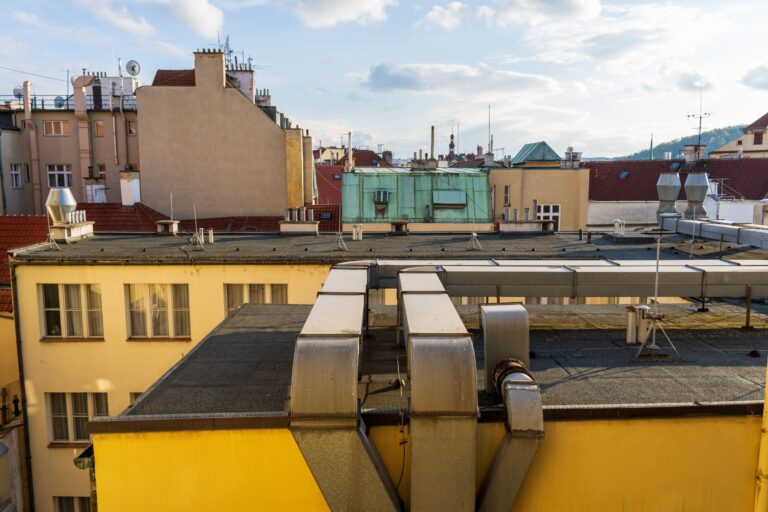


A flat roof lets water through not because the covering is “bad”, but because something went wrong at the fall, a detail or the preparation. Eurokas covers flat roofs so the result lasts for decades — we start not with a price but with a diagnosis, and we work with every major covering system.
3
covering systems: torch-on bitumen, PVC and TPO membranes
2
inspections a year — maintenance that extends the covering's life
1
goal: the building stays dry throughout the works
What the flat roof covering service includes
Our scope always covers not just the membrane but the whole solution: assessing the current state, preparing the substrate, checking the fall, sorting the details (parapets, outlets, penetrations) and controlling for water-tightness. It is these, not the name of the membrane, that decide whether the roof lets water through.
- Site survey and assessment of the covering’s condition
- Substrate preparation and, where needed, fall correction
- Laying the new covering in the chosen system
- Detailing at parapets, outlets and penetrations
- Water-tightness check and handover with photos
Details matter more than the membrane
Almost anyone can lay the field correctly. Whether the roof stays dry is decided at the parapets, outlets and penetrations — so we give the details as much attention as the covering itself.
The covering systems we work with
We do not push a single “best” covering for every case — we choose the system to suit the roof, the structure and how it is used.
| System | Where it fits best |
|---|---|
| Torch-on bitumen | When robustness and a reserve matter — a two-layer system |
| PVC membrane | When the structure limits weight and quick installation helps |
| TPO membrane | When ecology and resistance to UV and heat matter |
How the work runs: from survey to handover
Every project starts with a survey, where we assess the age of the covering, the fall and the riskiest spots. Only then do we give a quotation with a clear scope. During the works the building stays protected from moisture, and at the end we hand over photos of the spots that are no longer visible on the surface.
What to have ready before getting in touch
Photos of the problem spots, information about the building’s age and earlier work, and access details. The more that is known in advance, the more accurate the first assessment.
Recover or replace the whole covering
Stripping the old roof back to the deck is not always necessary. If the covering is still sound and the defects are local, recovering is often enough — faster and more economical. But once moisture has reached the insulation, too many layers have built up, or the defects keep recurring across the roof, a spot fix only postpones an unavoidable replacement. During the survey we tell you plainly which route makes sense in your case, and we do not propose the more expensive job where the cheaper one is enough.
Quality control and warranty
Quality is decided during the works, not at the end — so we control every stage: the substrate being dry before laying, the widths of the laps, the water-tightness of the details. Before the layers are closed we photograph the spots you will never see again — the vapour-barrier joints, the direction of fall, the fixings. Those photos stay with you together with the warranty on our work: if we ever need to come back, we will know exactly what was done and where.
Why the cheapest quote is often the dearest
If the price is lower because preparation was skipped or a thinner covering was chosen, the saving comes back as a repeat repair. Compare not just the sum, but what is included in it.
Where we work
We cover flat roofs in Vilnius, Kaunas and across Lithuania, and for larger projects across the European Union. We work on private houses, apartment blocks, commercial and logistics buildings. Wherever the building is, the process is the same: a survey and a clear scope first, then the work.
Frequently asked questions
It depends on the structure, the weight reserve and how the roof is used. During the survey we assess the roof and recommend the most suitable of bitumen, PVC or TPO — not the other way round.
Yes, we provide a warranty on our work. It is important to distinguish a warranty from the covering’s service life — we explain both in the contract.
We carry out most work in the warm season, but we always plan around the weather and your building’s situation.
Yes. Apartment roofs have their own specifics — vent shafts, internal drainage — so we pay separate attention to the details.
Need your flat roof assessed?
We start with a diagnosis, not a price — we survey the roof and give you a clear proposal.
Want to understand the technical side? You will find a full guide to flat roof structure, fall and layers in the article Flat roof installation: structure, slope, layers.